
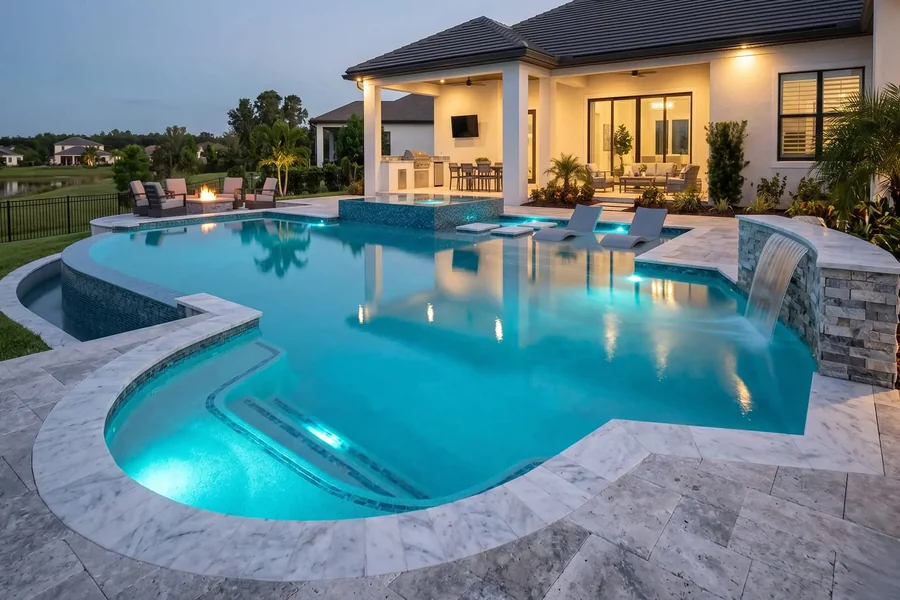
Say your 80-unit Fort Myers community has penciled in $150,000 to $300,000 for a new pool. That budget is rarely the first number to break. The schedule is. Boards that call in a commercial pool builder Fort Myers FL managers already trust, and do it before the drawings are final, tend to hold both numbers. Compliance gets solved on paper that way, instead of out in the mud with a crew standing around. The argument is plain enough. Money on a commercial build is won or lost at permitting and durability, not in haggling over tile. What follows is the checklist a board should run before it votes.
Commercial Pools Fail On Compliance First
A backyard pool answers to the homeowner. A pool serving eighty units answers to the state, to a federal drain-cover rule, and to every resident who walks a toddler down at seven in the morning. Under 16 CFR 1450.3, every drain cover sold for a pool or spa in this country must conform to the ANSI/APSP/ICC-16 2017 anti-entrapment standard. A commercial pool needs compliant main-drain covers with a properly engineered suction system behind them. Accessible entry and clearly painted depth markings are code items too, not upgrades to argue about at the next meeting. The case we see most often is a board that priced a residential pool and then found out it had bought a public one.
Health Department Rules Set The Baseline
In Florida a pool serving an apartment or condo community counts as a public pool. The Florida Department of Health regulates those under Chapter 64E-9 of the Florida Administrative Code. Plan review comes first, construction second, and an operating permit only after the final inspection clears. If your amenity is gated and residents only, you are still inside that system; if you are pouring a private pool behind your own house, you are not. That one distinction changes the drawings, the equipment room and the price.
Ask the builder who prepares the submittal and who stands with the inspector on site. The answer tells you whether the permit is their job or quietly yours. A crew that has walked a Lee County plan review before will hand you the document list without looking anything up. On approval day that is worth more than a lower bid.
High Traffic Demands Different Construction
Eighty units produce a bather load a residential pool would never see, and everything downstream of that number changes. Filtration turnover, gutter design, deck slip rating and tile that survives scrubbing three times a week all get specified differently, because the failure mode on a busy amenity is steady wear rather than neglect, and wear arrives on a schedule. Half the deck failures I have walked traced back to drainage, which is really a site grading problem. Grading then turns into an argument with the landscape crew, who will insist the irrigation was there first. Back to the pool. That fight is the reason a commercial builder belongs in the room during civil design, not after the concrete truck is scheduled.
Cut corners on the shell and you pay for it twice. The second time is worse, because the amenity sits closed while you do.
Budget And Downtime Every Board Underestimates
The shell is not usually where a board gets surprised. Perimeter safety fencing is a real line, and Sherwood News, citing HomeGuide, reported that adding a pool fence runs roughly $600 to $4,400 depending on material and length. Nobody enjoys pricing a fence, and the inspector will not sign the permit without one. Then come equipment room upgrades, an accessible lift, a chemical controller, and the deck nobody wrote into the estimate. Closed amenity months cost a community more than any tile upgrade ever will. A closed summer is what residents remember at renewal time.
Ongoing service deserves its own line while you are still pricing the build. PoolDial’s June 2026 service benchmarks pegged solo operators at $11,250 in median monthly revenue, against $48,450 for outfits running a full team. That gap is a blunt way of seeing who has the staff to keep an eighty-unit amenity open seven days a week. Get the maintenance number in front of the board at the same meeting as the construction number.
What The Build Timeline Really Looks Like
The first week after signing is paperwork, not dirt. Survey work, engineering and the health-department submittal eat the front end, and plan review can sit for weeks before anyone touches the site. Excavation, steel and plumbing follow, and by month three a typical project is into shell, deck and equipment set. Order the lift and the controller early, because a backordered part can stall a finished shell. Within 90 days of the first pour most builds are in finish work, waiting on final inspection and the operating permit. The permit clock does not care about your leasing calendar. Build that reality into the vote instead of into an apology email in July.
Approving A Commercial Build With Confidence
Run the checklist in order. Compliance, the health-department path, a construction spec sized for the real bather load, a budget with downtime priced in, and a timeline the board can defend to residents. A commercial pool builder Fort Myers FL boards keep rehiring will answer all five without reaching for a slide deck. The pool is an asset on the property’s books, and it only holds that value while it is open, compliant and busy. Vote on the plan, not the rendering.