
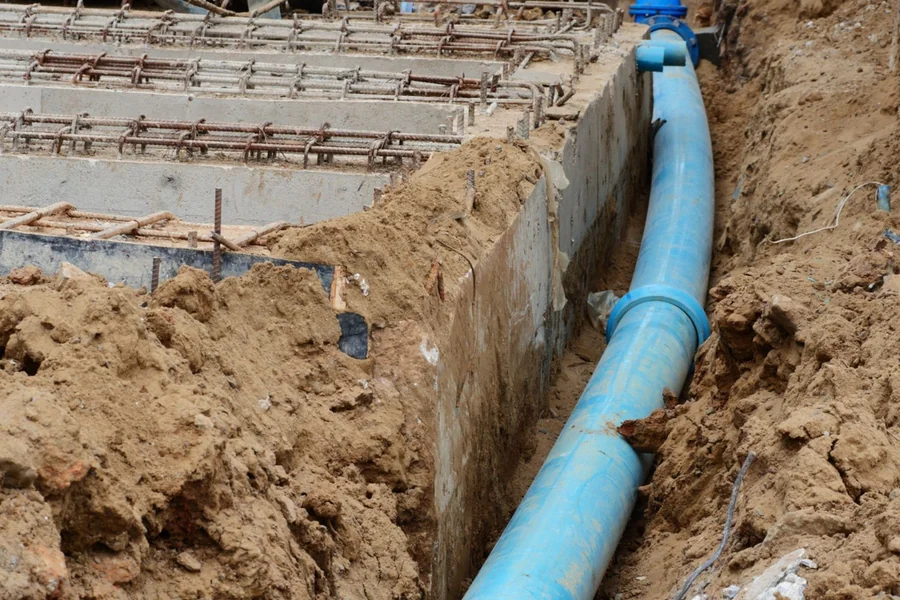
Dale closed on a shuttered barbecue building off a Harrison side street for $185,000, tenant interest in hand and a kitchen contractor holding a start date. Three weeks later he was calling around for civil contractors harrison ar with a rehab schedule he had already committed to on paper. His inspection had covered the roof, the electrical panel, and the hood over the cook line. Nobody put a camera down the sewer lateral, and that lateral turned out to be old clay running toward a tie-in two hundred feet away across a right of way.
The figures here are a scenario, rounded off, but the shape is real. Pricing the underground scope before you close costs a survey fee and a camera run. Finding out afterward costs the schedule, the contingency, and sometimes the deal. That applies to storefronts, small warehouses, and any building whose plumbing predates the current code book.
Underground Work Is The Line Diligence Skips
Commercial diligence has a shape, and the shape is aboveground. Roof age, panel capacity, parking surface, restroom layout, hood suppression, all of it gets bid, because a person can stand there and look at it. The case I run into most often on small Ozark storefront deals is a buyer holding four quotes on visible work and not one number for the sewer lateral or the water service. A place that was operating two years ago feels like proof the utilities are fine.
Think about a dental crown. The X-ray runs ninety dollars and it decides whether you are looking at a filling or a root canal, and nobody argues about the ninety once that is explained. A sewer camera and a utility locate do the same job on a building purchase, except the gap between the two possible answers is measured in tens of thousands.
A Site Walk Turns Assumptions Into Numbers
The buyers who avoid Dale’s problem bring civil contractors harrison ar onto the site before the money is committed. A crew marks where the lateral should run, cameras it, and locates the dry utilities. Call 811 before anyone digs, every time; that call is free and it is not optional. A survey then ties the elevations together so the engineer can say whether gravity carries the flow to the main or whether a pump joins the budget permanently. Stakes go in the ground. What comes back is a scope with quantities, which is the difference between a guess and a bid.
Nobody volunteers this work. The ground keeps its own books, and a seller has no reason to open them.
Questions That Separate Bidders Before Money Moves
Three bids on underground work rarely describe the same job, which is the part that trips up first-time buyers. One assumes open cut, another prices a bore under the drive, a third quietly leaves out the pavement patch. Ask these before anyone gets a deposit.
- Who surveys and stakes this, and is that cost inside your number or billed separately? A good answer names the surveyor and a dollar figure.
- What happens to the price if the trench hits rock at four feet? A good answer gives a per-foot adder rather than a shrug.
- Are the permit and right-of-way fees in your bid, and who pulls them? A good answer says which office and roughly what it charges.
- Who talks to the engineer and the inspector when something changes mid-trench? A good answer is a name and a phone number, not a vague reference to the office.
Search for local excavation outfits and you will get a page of companies claiming the same fifteen years and the same heavy equipment. The answers to those four questions sort them faster than any of that. What you want is the bidder who has already coordinated with an engineer and an inspector on a right-of-way tie-in, because that is where a schedule either holds or slips a month.
Price The Dirt Before You Price The Deal
Published cost data is worth reading, with a caveat. A January 2026 RSMeans commercial construction and renovation package prices sewer line installation for a commercial renovation between $1,420 and $5,770 total, depending on pipe material, trenching requirements and permit fees. That range assumes a short run to a main sitting roughly where you expect it. Dale’s lateral and tie-in came to $18,000. Honestly, closer to $24,000 once the right-of-way permit and traffic control landed, and with $1,900 for locates, camera work and staking plus $700 in permits, his underground total hit $26,600. Against a $185,000 purchase and a $57,000 rehab budget, that is eleven percent of the project, found in the wrong order.
The work that saves a deal like this is boring and cheap. A camera, a locate, a survey, stakes, and a bid carrying quantities, all done while walking away is still an option. Dale says he would have asked the seller for $20,000 back, and a seller on a stale listing might have met him partway. Price the dirt first, and the underground stops being the line that breaks the deal.