
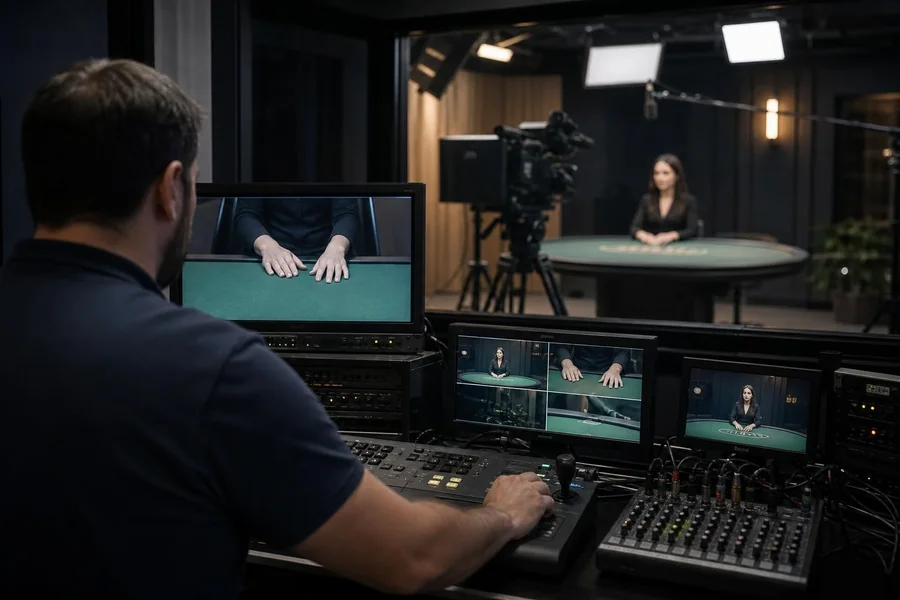
For Liverpool supporters watching in Canada or the US, live coverage depends on people they rarely see. Engineers keep cameras, sound equipment and transmission systems working while attention stays on the pitch. Similar skills support the studios producing live-dealer casino games.
The live tables on an online casino ontario website connect a customer-facing platform to a specialist supplier’s studio and software. That studio may be outside the province. ToonieBet, for instance, carries its own exclusive Gold Saloon live tables produced by Evolution. Behind the dealer on screen are technicians responsible for the pictures, sound, connections and records that make the service work.
Before the Dealer Appears: Building the Broadcast
A live studio starts with installation work: mounting cameras, connecting microphones, positioning lights and running cables. Audiovisual specialists also maintain processing equipment and can help build the surrounding set, including gaming tables and studio infrastructure.
Supplier job descriptions show the range of skills involved. Camera aperture settings control the light entering the lens; colour balance, frame rates and video switching affect the picture. Audio mixing shapes the sound reaching the audience.
There is a practical side to the job, too. Roles call for experience making cable connections, using measurement tools and working with building materials. Someone has to install the mounts and connect the equipment before software can carry a picture anywhere.
Those physical connections form the starting point for everything that reaches the player’s screen.
From the Table to the Screen: Connecting Video and Game Data
When the dealer begins, several processes run together. Cameras capture the action, microphones pick up speech and encoding equipment prepares the video for transmission. Encoding converts captured footage into a form that can be sent and played digitally.
The player’s interface adds another layer. It displays game information and receives instructions through browser applications built by software engineers.
Results also pass into the system as data. The Live Gaming Studio Guide, released in draft form by Gaming Laboratories International in July 2026, covers accurate recording of outcomes and the use of automated recognition. It includes procedures for correcting erroneous readings.
The guide addresses messages as well: players should receive clear acknowledgement of wagers, with spoken and displayed instructions reasonably synchronized. Engineers working on the broadcast and application therefore share a concern: keeping the physical action and on-screen information aligned.
Keeping the Studio Running Around the Clock
Once production is underway, maintenance becomes a continuing responsibility. Technical operations staff calibrate broadcast equipment, oversee studio infrastructure and monitor conditions in spaces such as server rooms.
The work involves video, audio, IT, equipment support and studio engineering teams. Technical leads assign tasks, arrange equipment purchases and coordinate improvements alongside ongoing production.
Equipment inventories and installation procedures matter here. They organize the tools, materials and methods used for repairs and new builds. Job descriptions also include assessing training needs and sharing technical information between departments.
Preparation extends to failures. Technical operations roles include contingency planning for emergencies during live broadcasts. Staff need agreed procedures ready for the moment a connection drops or equipment requires attention.
When Something Goes Wrong: Troubleshooting and Recovery
An interruption may affect pictures, sound or game data. Studio-assessment guidance covers connection outages and server malfunctions, alongside rules explaining to players how interruptions will be handled.
In Ontario, fault response also carries regulatory duties. Operators must make a game unavailable when a suspected game or system fault could affect integrity or fairness, keeping it unavailable until the issue is resolved.
Other requirements address recovering outcomes where technically possible and resolving transactions fairly. If a game cannot continue after an interruption, the standards provide for payment of winnings reached or return of wagers, whichever gives the player the better outcome.
Investigators need evidence to establish what happened. Technical staff preserve relevant records and examine the fault, supporting decisions about the affected round and the work needed before service resumes.
Making Each Round Traceable
Much of that evidence is created during ordinary play. Studio-assessment guidance covers continuous recordings, clear camera coverage and timestamps synchronized with relevant systems. Together, these allow a round to be reconstructed and reviewed.
Ontario’s standards require mechanisms for recreating a game through the last state communicated to the player. They also restrict access to live-dealer equipment according to business need, with changes logged and access privileges reviewed.
The technicians’ work reaches beyond the outgoing feed. Their equipment and systems help preserve an account of what appeared on screen and what happened at the table.
Personal safeguards remain important. Ontario’s regulated online gambling market is for adults aged 19 and over who are physically in the province. Gambling carries financial risks. Anyone concerned about their own gambling or someone else’s can find support and self-exclusion information through iGaming Ontario’s player guidance.