
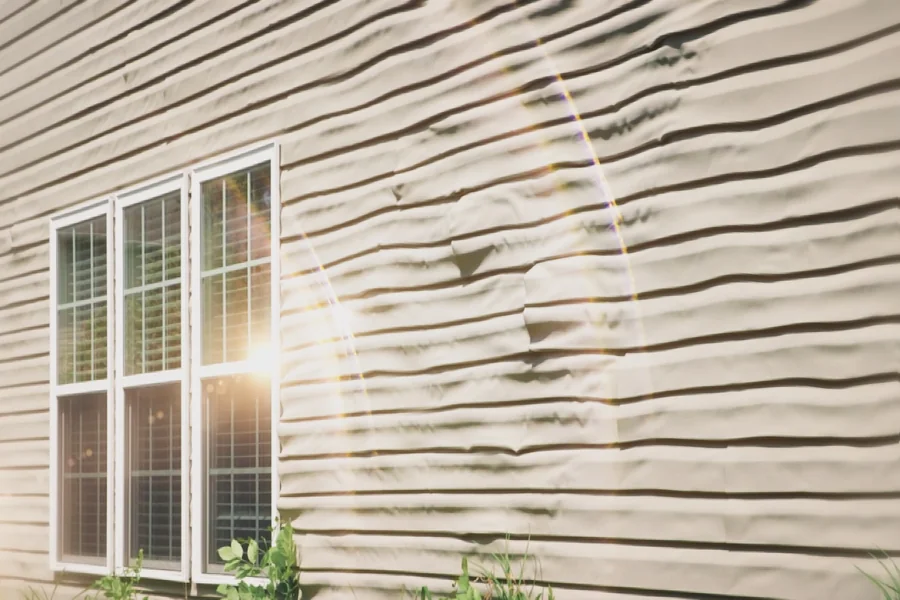
Marcus bought his two-story in a 1990s Upper Arlington subdivision back in 2014, and for eleven of those twelve years the siding gave him nothing to think about. Then a refinance appraisal put him on a ladder, and by early spring he was calling around to siding companies upper arlington oh homeowners use for full exterior work. Three elevations looked close to new. The south wall did not: chalky, faded two shades lighter, panels cupped away from the sheathing and brittle enough to crack when he pressed a thumb into one. His instinct was to budget a few thousand for cosmetic touch-ups spread around the house, which is the mistake this article is about. When one elevation fails years ahead of the others, the money belongs on that wall and the substrate behind it, not spread across all four in work that fixes nothing.
Judging Siding From The Street Misses The Damage
A curb view is the cheapest inspection available and the least useful one. Drive-by assessments start on the elevation facing the road, which in subdivisions of that era is often north or east, and those walls hold their color for decades while the sun works the opposite side of the house. What we find on walk-arounds is one wall aged like it belongs to a different building. Pull the build year off the Franklin County Auditor’s free property search before anyone quotes you, because a 1996 house wearing its original entry-level vinyl is a different conversation than a 2011 re-side, and the year tells you which one you own.
Spot Replacing Faded Panels Rarely Matches
Here is where budgets go sideways. Owners order a box of matching panels, swap the worst dozen, and end up with a wall that reads as two colors, because twelve years of ultraviolet exposure has moved the original somewhere no factory chip will meet. Vinyl fades unevenly and it fades permanently. Even a discontinued profile that still exists as a part number comes out of the mold at day-one color.
Ask whichever siding companies upper arlington oh owners shortlist to bring a sample of the actual replacement stock and hold it against the weathered wall in daylight, not under a garage bulb. Nine times out of ten the mismatch is obvious in about ten seconds. If it is not, you have found a rare match, and you should still buy enough for the whole elevation while it exists.
A Moisture Meter Answers What Eyes Cannot
Brittle panels are a symptom, and the question that decides the budget is what happened behind them. Cupped vinyl opens gaps at the laps, wind-driven rain gets past, and the weather barrier and OSB underneath take it for years without a hint from outside. A pin meter pressed into the sheathing at four or five points along the bottom course settles it in under a minute: readings in the low teens are dry, and anything much over 20 percent means the wall has been wet long enough to matter. That reading is the difference between a re-side and a re-side plus sheathing, framing repair and a new barrier. In practice the failed south wall is the one that reads high, partly because it dries fastest between storms and hides its own history. I honestly cannot tell you how often the substrate turns out to be wet on jobs like this, since nobody tracks it and the numbers other crews quote me vary so widely that repeating one would be guessing. You find out when the panels come off.
Patchwork Repairs Show Up In Photographs
Appraisers and buyers photograph the whole exterior, and mismatched panels read as deferred maintenance no matter how sound the repair underneath is. That lands harder on a refinance than owners expect, since the report captures condition rather than receipts. There is a product side to this too. One June 2026 industry comparison, citing Vinyl Siding Institute product data, puts vinyl’s usable life at 20 to 40 years, with entry-level 0.040-inch panels showing fade and brittleness by 15 to 20 years on hot south-facing walls while premium 0.046 to 0.055-inch stock carrying ultraviolet stabilizers routinely reaches 30 to 40. Re-siding a failed south elevation in that same thin grade buys another dozen years of the same complaint. Stepping the gauge up on one wall costs far less than doing the entire house in it.
Fixing The Wall That Actually Failed
The fix is unglamorous. Assess four walls, meter the sheathing, replace the elevation that quit in a better grade than the one that failed, and leave the three sound walls alone until they earn the attention. On a house where one elevation has failed early, the budget belongs on that wall and the sheathing behind it, not spread evenly around a house that is mostly fine. Marcus re-sided a single wall, replaced roughly forty square feet of soft OSB, and kept the rest of his estimate for the windows he actually needed. A contractor who walks all four elevations before quoting is not padding the visit. That walk is what tells you which of your dollars are doing work.