
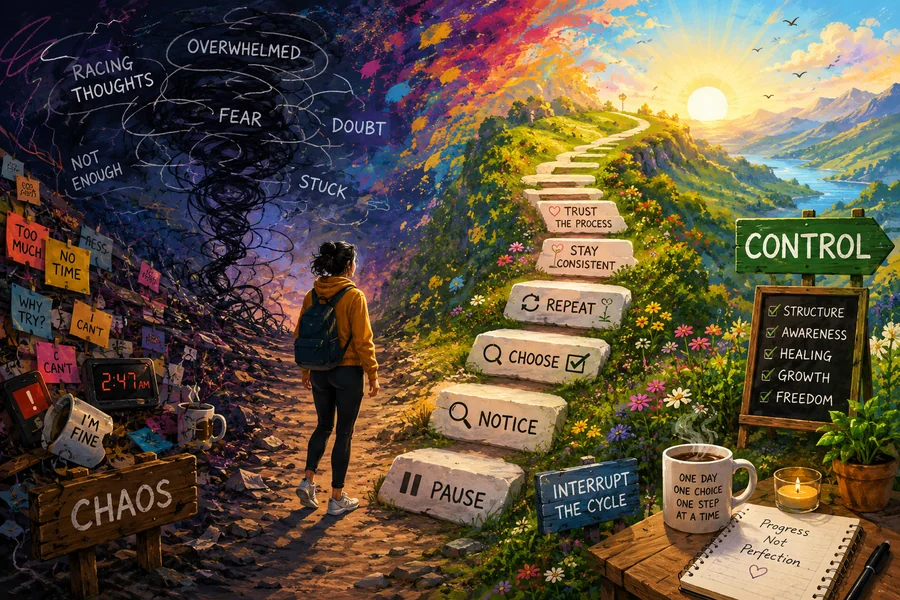
There is a certain kind of exhaustion that doesn’t come from lack of effort, but from trying to hold everything together at once. Life feels unpredictable, thoughts move faster than decisions, and even small choices can feel overwhelming. In moments like these, change is rarely about dramatic transformation. More often, it begins as something quieter—a slow shift from chaos to control that happens in layers, not leaps.
Personal change, especially when it involves deeply ingrained habits or emotional patterns, rarely follows a straight path. It unfolds unevenly. Some days feel stable, others feel like a return to old patterns. But over time, something subtle begins to take shape: a growing sense of steadiness where instability once lived.
This gradual movement is especially visible in journeys connected to Drug Addiction Treatment, where change is not just behavioral but emotional, psychological, and often deeply relational. Yet the same principle applies broadly to anyone rebuilding their life from a place of overwhelm.
Chaos Is Not Just External—It’s Internal Too
When people think of chaos, they often imagine visible disorder: missed responsibilities, broken routines, or unstable environments. But the deeper form of chaos is internal.
It shows up as:
- Racing thoughts that refuse to settle
- Emotional reactions that feel bigger than the moment
- Difficulty trusting decisions, even small ones
- A constant sense of “falling behind” life itself
This internal noise can make even simple structure feel unreachable. And in that space, control doesn’t feel like something to build—it feels like something lost forever.
But chaos is not a fixed identity. It is a state. And states can change.
The Myth of Instant Control
One of the most discouraging beliefs people carry is that control should arrive suddenly. That one day, clarity will replace confusion, and discipline will replace struggle.
But real change rarely works that way.
Control is not a switch. It is a skill built through repetition under imperfect conditions. It grows in moments that often feel too small to matter:
- Choosing to pause instead of reacting immediately
- Following through on a plan even when motivation is low
- Noticing emotional triggers without acting on them
- Returning to structure after disruption without self-punishment
These moments don’t look transformative on their own. But together, they form the architecture of stability.
In contexts like Drug Addiction Treatment, this misunderstanding is especially important. Many assume recovery is a single turning point. In reality, it is a long sequence of micro-decisions that slowly rebuild internal order.
Why Change Feels Slow (Even When It’s Working)
Progress in personal transformation is often non-linear. This is not a failure of effort—it is how the brain adapts.
When long-standing patterns begin to shift, the mind does not immediately trust the new structure. It tests it. It resists it. It occasionally returns to familiar patterns because familiarity feels safer than uncertainty.
This creates a confusing experience: improvement and relapse-like behavior can exist in the same timeframe.
But underneath that inconsistency, something important is happening:
- New neural pathways are forming
- Emotional regulation is strengthening
- Awareness is increasing before reaction
- Recovery from impulsive cycles is shortening in duration
What feels like stagnation is often recalibration.
Control Begins With Small Interruptions
The transition from chaos to control rarely begins with mastery. It begins with interruption.
An interruption is any moment where the usual cycle does not complete itself.
For example:
- A familiar urge arises, but action is delayed
- A habitual reaction is noticed before it escalates
- A destructive thought pattern is identified mid-stream
- A pause happens where there used to be automatic behavior
These interruptions are powerful because they create space. And space is where change becomes possible.
In many recovery-oriented frameworks, including those connected to Drug Addiction Treatment, this concept is central. The goal is not perfection, but interruption—breaking the automatic chain long enough for choice to enter.
The Role of Emotional Safety in Regaining Control
No one builds lasting control in a state of constant emotional threat. The nervous system does not learn well under pressure; it adapts through safety and repetition.
When a person begins to feel even slightly safer—internally or externally—something shifts:
- Decisions become less reactive
- Reflection becomes more accessible
- Shame loses some of its authority
- Planning becomes possible again
This is why progress often feels slow at first. The system is not just learning new behaviors; it is learning that change is safe enough to sustain.
Without that sense of safety, even the best strategies collapse under stress.
Structure Is Not Restriction—It Is Relief
At first, structure can feel limiting, especially when life has been unpredictable. But over time, structure becomes something else entirely: relief.
A simple routine removes the burden of constant decision-making. Predictability reduces mental load. Clear patterns reduce internal negotiation.
Structure does not eliminate freedom. It makes freedom usable.
This is why consistent routines are often emphasized in approaches related to Drug Addiction Treatment and broader behavior change. They are not about control in a restrictive sense, but about reducing internal noise so clarity can emerge.
The Emotional Lag of Change
One of the most misunderstood parts of transformation is emotional lag—the delay between behavioral change and emotional belief.
A person may begin acting differently:
- Making healthier choices
- Avoiding previous triggers
- Following structured routines
But emotionally, they may still feel unchanged. This creates doubt: “If I still feel like this, am I really improving?”
The answer is yes—but emotion often follows behavior slowly.
Over time, repeated actions begin to reshape emotional response. Trust builds not through insight, but through evidence gathered over time.
Setbacks Are Not Reversals
In the slow shift from chaos to control, setbacks are not the opposite of progress—they are part of it.
A setback often reveals:
- Where structure is still fragile
- Which triggers remain sensitive
- What coping skills need strengthening
- How quickly one can return to stability
The key difference between regression and growth is not whether disruption happens, but how quickly recovery occurs afterward.
In long-term change processes, including Drug Addiction Treatment, this ability to return—rather than remain stuck in disruption—is one of the strongest indicators of progress.
Identity Begins to Catch Up With Behavior
At some point in the process, something subtle happens: behavior leads, identity follows.
A person who once thought, “I can’t stay consistent,” begins to notice consistency appearing more often. Someone who believed chaos was permanent starts to recognize moments of calm that last longer than expected.
Identity does not change through declaration. It changes through repetition.
Eventually, new behaviors stop feeling like effort and start feeling like normal.
That is the moment when control is no longer something being built—it is something being lived.
The Quiet Nature of Real Change
Perhaps the most surprising truth about personal transformation is how unremarkable it can look from the inside. There are rarely dramatic turning points that last forever. Instead, there are ordinary days that feel slightly less overwhelming than before.
Then weeks where recovery from setbacks is faster.
Then months where stability lasts longer than instability.
The chaos does not disappear overnight. It fades gradually, replaced by something quieter but stronger: steadiness.
Final Thoughts
The shift from chaos to control is not a single event. It is a long process of small corrections, repeated choices, and quiet persistence. It happens in moments that often go unnoticed while they are happening.
Whether in general personal development or in structured recovery journeys like Drug Addiction Treatment, the principle remains the same: change is built slowly, through consistency rather than intensity.
Control is not the absence of struggle. It is the growing ability to move through struggle without losing direction.
And that kind of control does not arrive suddenly—it settles in over time, until one day, it no longer feels like chaos is in charge.